
Haiti at a glance
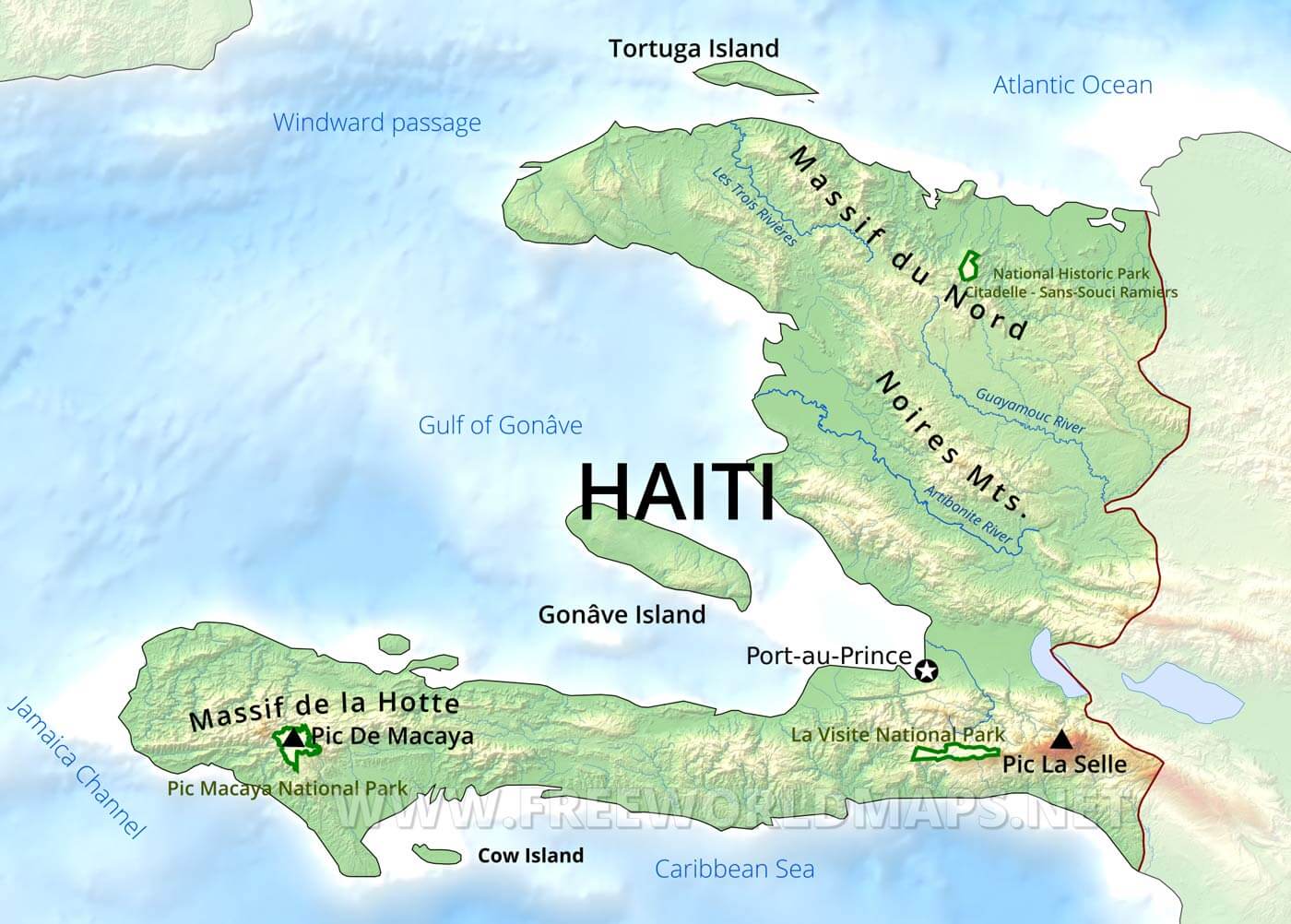
Haiti is the 3rd largest country in the Caribbean, occupying the western three-eighths of the island of Hispaniola, which it shares with the Dominican Republic. Positioned approximately 80 km to the east of Cuba across the Windward Passage, Haiti has 1,771 km of coastline. This mountainous territory lies between the Atlantic Ocean to the north and the Caribbean Sea to the south, and comprises several surrounding islands including La Gonâve, la Tortue (Tortuga), Île-à-Vache, and Navase.
Nationality: Noun: Haitian(s) Adjective: Haitian
Ethnic Groups: black 95%, mulatto and white 5%
Languages: French (official), Creole (official)
Religions: Roman Catholic 55%, Protestant 28.5% (Baptist 15.4%, Pentecostal 7.9%, Adventist 3%, Methodist 1.5%, other 0.7%), Vodou 2.1%, Spiritist 2.8%, none 10.2%, other 1.4% (2023 est.)
Note: Approximately half of the population practices elements of Vodou in combination with Christian denominations, most often Roman Catholicism. Protestantism has grown significantly since 2012.
Population: 12,037,506 (June 2026 est.) Country comparison to the world: 82
Age Structure:
0-14 years: 32.78%
15-64 years: 62.49%
65 years and over: 4.73% (2024 est.)
Median Age:
Total: 24.3 years
Male: 24.1 years
Female: 24.5 years (2026 est.)
Population Growth Rate: 1.22% (2025 est.)
Country comparison to the world: 93
Birth Rate: 21.12 births/1,000 population (2022 est.)
Country comparison to the world: 77
Death Rate: 8.24 deaths/1,000 population (2024 est.)
Country comparison to the world: 88
Net migration Rate: -2.65 migrant(s)/1,000 population (2023 est.)
Country comparison to the world: 173
Urbanization:
Urban population: 60.47% of total population (2024)
Rate of urbanization: 2.59% annual rate of change (2021-24 est.)
Major Cities / Population:
PORT-AU-PRINCE (capital) 3,133,000 (2025)
Sex Ratio: At birth: 1.01 male(s)/female
Under 15 years: 0.99 male(s)/female
15-64 years: 0.98 male(s)/female
65 years and over: 0.62 male(s)/female
Total population: 0.97 male(s)/female (2024 est.)
Life Expectancy at Birth:
Total population: 64.9 years Country comparison to the world: 188
Male: 63.26 years
Female: 68.67 years (2023 est.)
Total Fertility Rate: 2.43 children born/woman (2022 est.)
Country comparison to the world: 75
Health Expenditures: 3.22% of GDP (2024 est.)
Country comparison to the world: 171
Physicians Density: Data not available from recent surveys
Note: Reliable updated physician density data is unavailable. The 1998 estimate of 0.25 physicians/1,000 population is significantly outdated. Current health sector estimates suggest shortages remain critical.
Hospital Bed Density: Data not available from recent surveys
Note: The 2007 estimate of 1.3 beds/1,000 population is outdated. As of 2023, nearly 48% of hospitals in Port-au-Prince are in areas under gang control or influence, severely limiting functional capacity.
HIV/AIDS – Adult Prevalence Rate: 0.2% (2023 est.)
Country comparison to the world: 115
Note: HIV prevalence has declined dramatically since 2009, primarily due to expanded treatment and prevention programs. However, Haiti accounts for 38% of new HIV infections in the Caribbean region as of 2023.
HIV/AIDS – People Living With HIV/AIDS: Estimated 150,000 (2023 est.)
Country comparison to the world: 40
HIV/AIDS – Deaths: Approximately 2,500-3,000 annually (2023 est.)
Country comparison to the world: 40
Major Infectious Diseases:
Degree of risk: high
Food or waterborne diseases: bacterial and protozoal diarrhea,
hepatitis A and B, and typhoid fever
Vectorborne diseases: dengue fever, malaria, and Zika virus
Water contact disease: leptospirosis
Children under the age of 5 years stunted: 21.6% (2024 est.)
Country comparison to the world: 73
Education Expenditures:
1.2% of GDP (estimated 2021)
Literacy:
Definition: age 15 and over can read and write
Total population: 68.0%
Male: 70.0%
Female: 66.0% (2017 est.)
Note: Literacy has improved from 52.9% in 2003 but remains below 90% average for Latin America and Caribbean. Only approximately 50% of Haitian children complete primary school. Data from 2016 PAHO sources shows adult literacy at 83%, but UNESCO estimates are more conservative.
Maternal Mortality Rate:
328 deaths/100,000 live births (2023 est.)
Country comparison to the world: 35
Infant Mortality Rate:
Total: 46.87 deaths/1,000 live births (2024 est.)
Country comparison to the world: 39
Male: 50.2 deaths/1,000 live births
Female: 43.4 deaths/1,000 live births